ASComm IoT
GE IoT Software Driver Example Application
Simple Read and Write
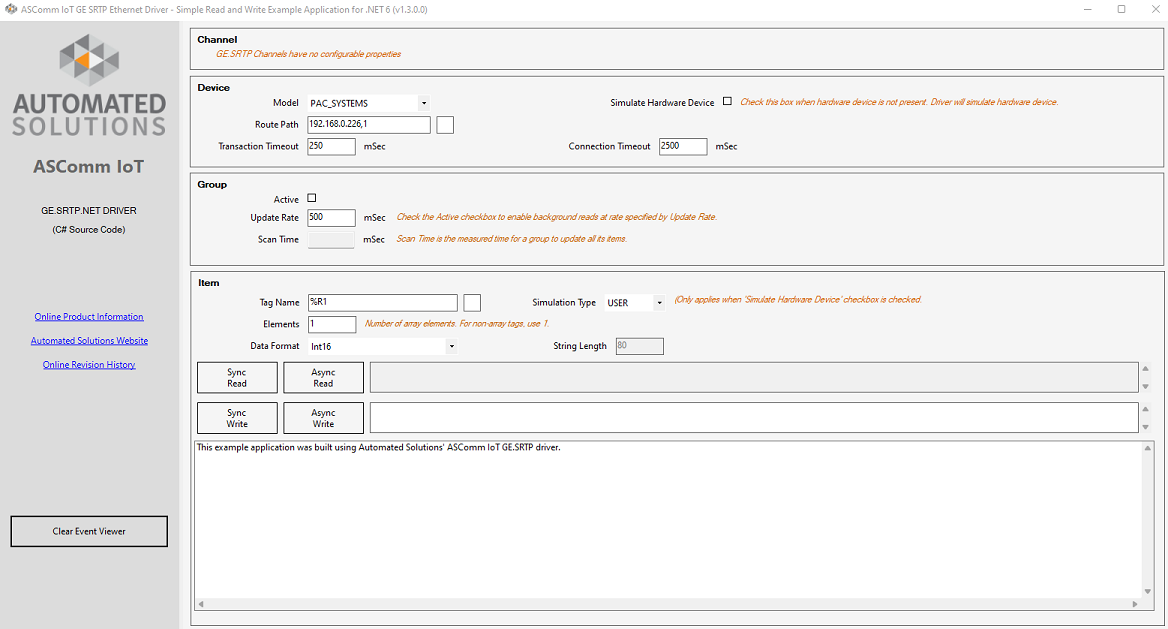
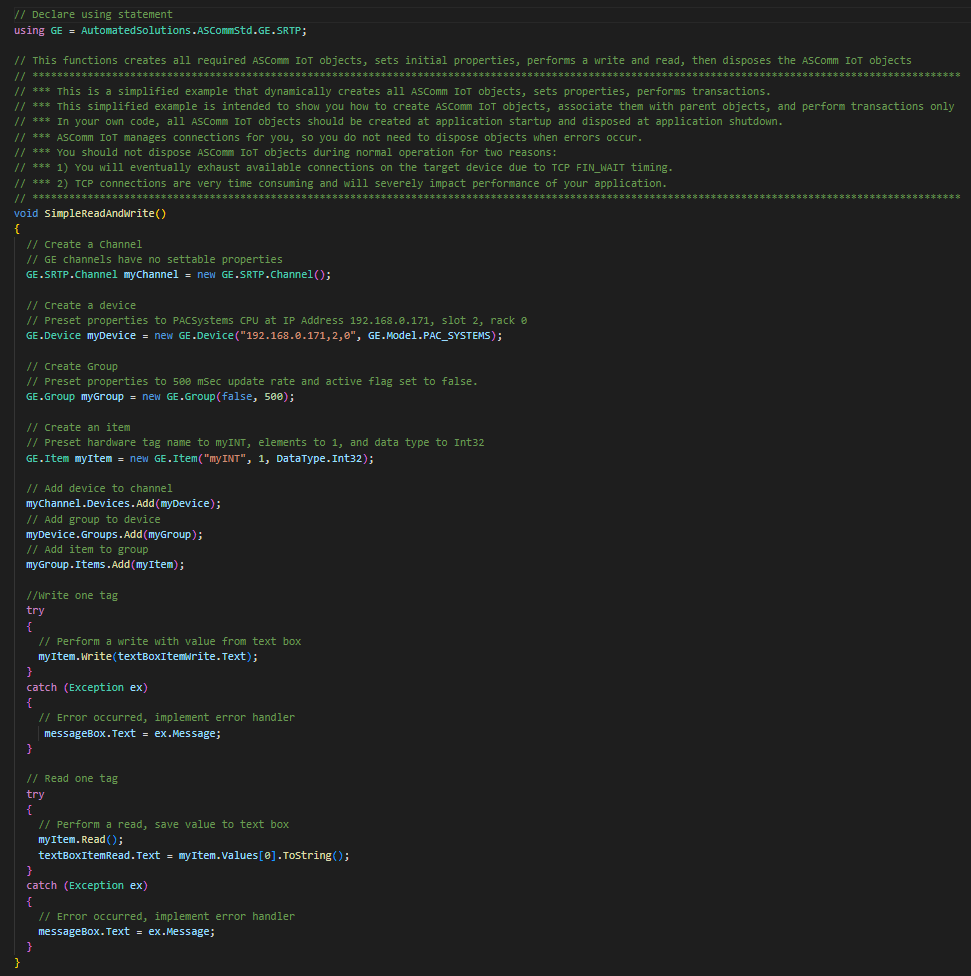
GE IoT Software Driver Code Example
ASComm IoT GE SRTP Ethernet Driver is a communications library that enables your .NET 10/9/8 applications to read and write registers on PACSystems RX3i, RX7i, Rxi, Series 90-30, and VersaMax controllers without PLC program modifications, OPC or third party libraries.
PACSystems symbolic register naming supported.
Use Visual Basic, C#, C++, and ASP.NET to create HMI, SCADA, data logging, and Industrial IoT applications targeting Windows, Linux and Android.
Powerful pre-built example applications with VB and C# source code included in development package.
Runtime-free for qualified applications
You don’t have to choose between a safe home and a private life. By being an intentional consumer, you can mitigate most risks associated with home security systems.
The future of home security isn't just about higher resolution or better night vision—it's about building systems that respect the very privacy they are meant to protect.
In many jurisdictions, you have a legal right to film public spaces (like the street) from your property, but filming areas where a neighbor has a "reasonable expectation of privacy" (like through their bedroom window) can lead to legal disputes or even harassment charges. How to Balance Security with Privacy
Guardian or Spy? Navigating the Intersection of Home Security and Privacy
Security cameras aren’t new, but their nature has shifted fundamentally. Old-school CCTV (Closed-Circuit Television) systems were "dumb" and localized. They recorded to physical tapes or hard drives kept inside the home. If someone wanted to see that footage, they generally needed physical access to the premises.
Today’s systems are cloud-based and AI-driven. They use facial recognition to tell the difference between a family member and a stranger, infrared sensors to see in total darkness, and high-gain microphones to capture whispers. While these features make us safer, they also mean our most private moments—conversations in the kitchen, routines in the hallway—are being digitized, uploaded to servers, and processed by algorithms. The Risks: Data Breaches and "The Eye in the Cloud"
If privacy is your top priority, look for systems that support NVR (Network Video Recorder) or SD card storage . This keeps your footage on your own hardware, off the internet entirely.
Privacy concerns don’t just stop at your front door; they extend to your neighbors. A camera angled too sharply might capture a neighbor’s backyard or their front windows. This has led to a new wave of "suburban surveillance" friction.
Be a good neighbor. Adjust your cameras to ensure they are focused on your entry points and property line, avoiding neighboring windows or private yards.
You don’t have to choose between a safe home and a private life. By being an intentional consumer, you can mitigate most risks associated with home security systems.
The future of home security isn't just about higher resolution or better night vision—it's about building systems that respect the very privacy they are meant to protect.
In many jurisdictions, you have a legal right to film public spaces (like the street) from your property, but filming areas where a neighbor has a "reasonable expectation of privacy" (like through their bedroom window) can lead to legal disputes or even harassment charges. How to Balance Security with Privacy
Guardian or Spy? Navigating the Intersection of Home Security and Privacy
Security cameras aren’t new, but their nature has shifted fundamentally. Old-school CCTV (Closed-Circuit Television) systems were "dumb" and localized. They recorded to physical tapes or hard drives kept inside the home. If someone wanted to see that footage, they generally needed physical access to the premises.
Today’s systems are cloud-based and AI-driven. They use facial recognition to tell the difference between a family member and a stranger, infrared sensors to see in total darkness, and high-gain microphones to capture whispers. While these features make us safer, they also mean our most private moments—conversations in the kitchen, routines in the hallway—are being digitized, uploaded to servers, and processed by algorithms. The Risks: Data Breaches and "The Eye in the Cloud"
If privacy is your top priority, look for systems that support NVR (Network Video Recorder) or SD card storage . This keeps your footage on your own hardware, off the internet entirely.
Privacy concerns don’t just stop at your front door; they extend to your neighbors. A camera angled too sharply might capture a neighbor’s backyard or their front windows. This has led to a new wave of "suburban surveillance" friction.
Be a good neighbor. Adjust your cameras to ensure they are focused on your entry points and property line, avoiding neighboring windows or private yards.